
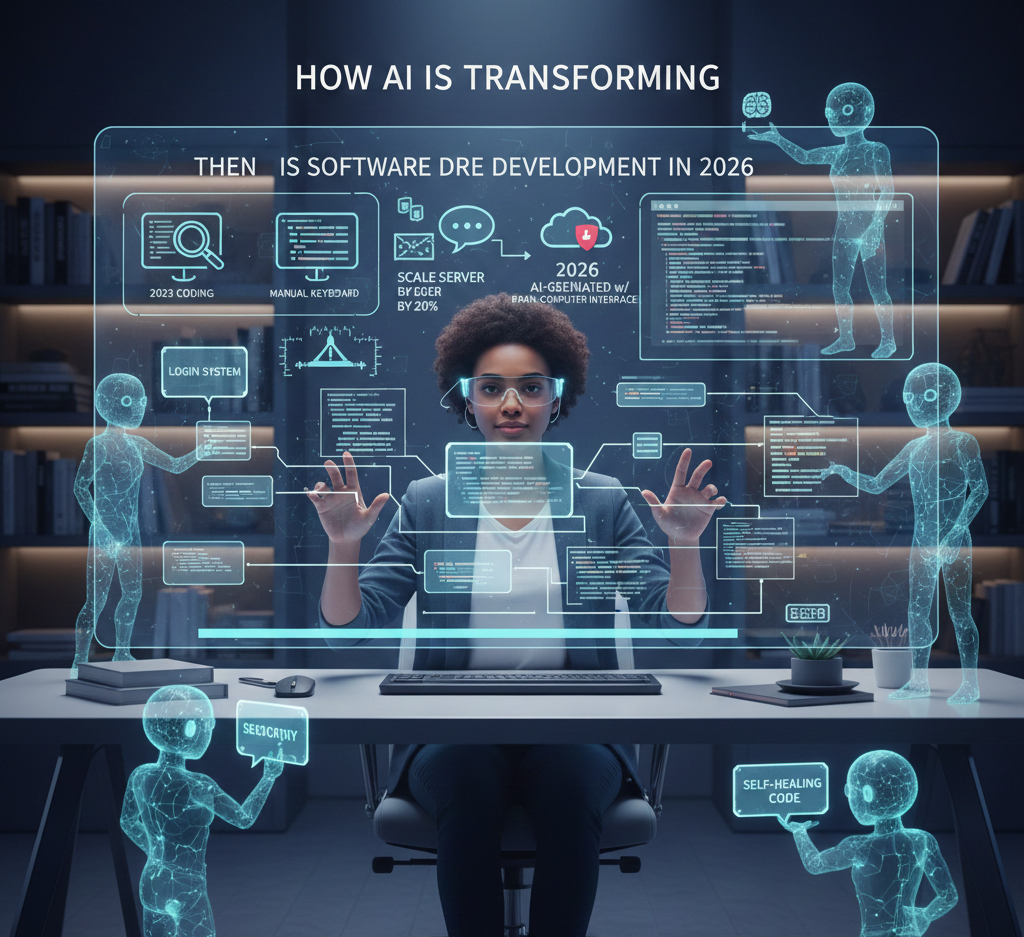
If you’re a student today, you’re not just learning to code; you’re learning to lead a digital workforce. In 2026, the “lonely programmer” archetype is gone. Today, every developer is more like a Conductor managing an orchestra of AI agents. Let’s look at how the world of software has changed this year and what it means for your future career.
1. From “Copilots” to “Autonomous Agents”
Remember when AI just suggested the next line of code? Those were the “Copilot” days. In 2026, we use AI Agents.
Instead of writing a function, you now give a high-level command: “Build a login system with two-factor authentication and connect it to our database.” The AI doesn’t just suggest code; it creates the files, sets up the security protocols, and tests the logic while you watch.
Key Change: We are moving from writing code to reviewing logic. Your job is to make sure the AI’s “plan” is correct and secure.
2. “Self-Healing” Code and Automated DevOps
In the past, when a website crashed at 3 AM, a human developer had to wake up and fix it. In 2026, we have Self-Healing Systems.
AI now monitors servers in real-time. If it detects a bug or a slowdown, it can:
- Identify the exact line of code causing the issue.
- Write a “patch” (a fix).
- Test the fix in a safe environment.
- Deploy it—all before the human team even finishes their morning coffee.
3. Natural Language is the New Syntax
You still need to understand Python, Java, or C++, but Natural Language (the way we speak) has become a powerful programming tool.
With PromptOps, developers use “conversational engineering” to manage entire cloud infrastructures. You might tell your terminal: “Scale the server capacity by 20% because we’re expecting a traffic spike during the sale tonight,” and the AI handles the complex cloud configurations instantly.
🕒 The “Then vs. Now” Comparison (2023 vs. 2026)
| Feature | Software Dev in 2023 | Software Dev in 2026 |
|---|---|---|
| Coding | Manual typing and StackOverflow | AI-generated multi-file codebases |
| Testing | Writing manual test cases | AI predicts failures and auto-tests |
| Debugging | Hours of searching for a semi-colon | AI explains the bug and fixes it |
| Documentation | Always outdated / Boring to write | Auto-generated and updated in real-time |
🎓 What Should Students Focus on Now?
If the AI is doing the “heavy lifting” of coding, what should you learn? To be a top engineer in 2026, you need these three skills:
1. System Architecture: You need to understand how different parts of a system (databases, frontend, APIs) fit together. The AI builds the bricks; you design the building.
2. AI Orchestration: Learn to use tools like Devin, GitHub Copilot Agent Mode, and Cursor. Knowing how to “talk” to AI to get the best result is a superpower.
3. Critical Thinking & Ethics: AI can make mistakes or include “biases.” As a human, your value lies in your ability to judge if a solution is ethical, safe, and truly what the user needs.
Final Thoughts
AI isn’t replacing developers; it’s replacing the boring parts of development. This is the best time in history to be a student because you can build massive, complex apps that used to require a team of 50 people, all by yourself with your AI partners.
The future isn’t about “Man vs. Machine”—it’s about “Man + Machine.”